Delegate a Linear issue.
Delegate or @mention Rivets on an issue and work starts. Progress, Agent Plans and follow-ups stay in sync, and the pull request links back with “Fixes ABC-123”.
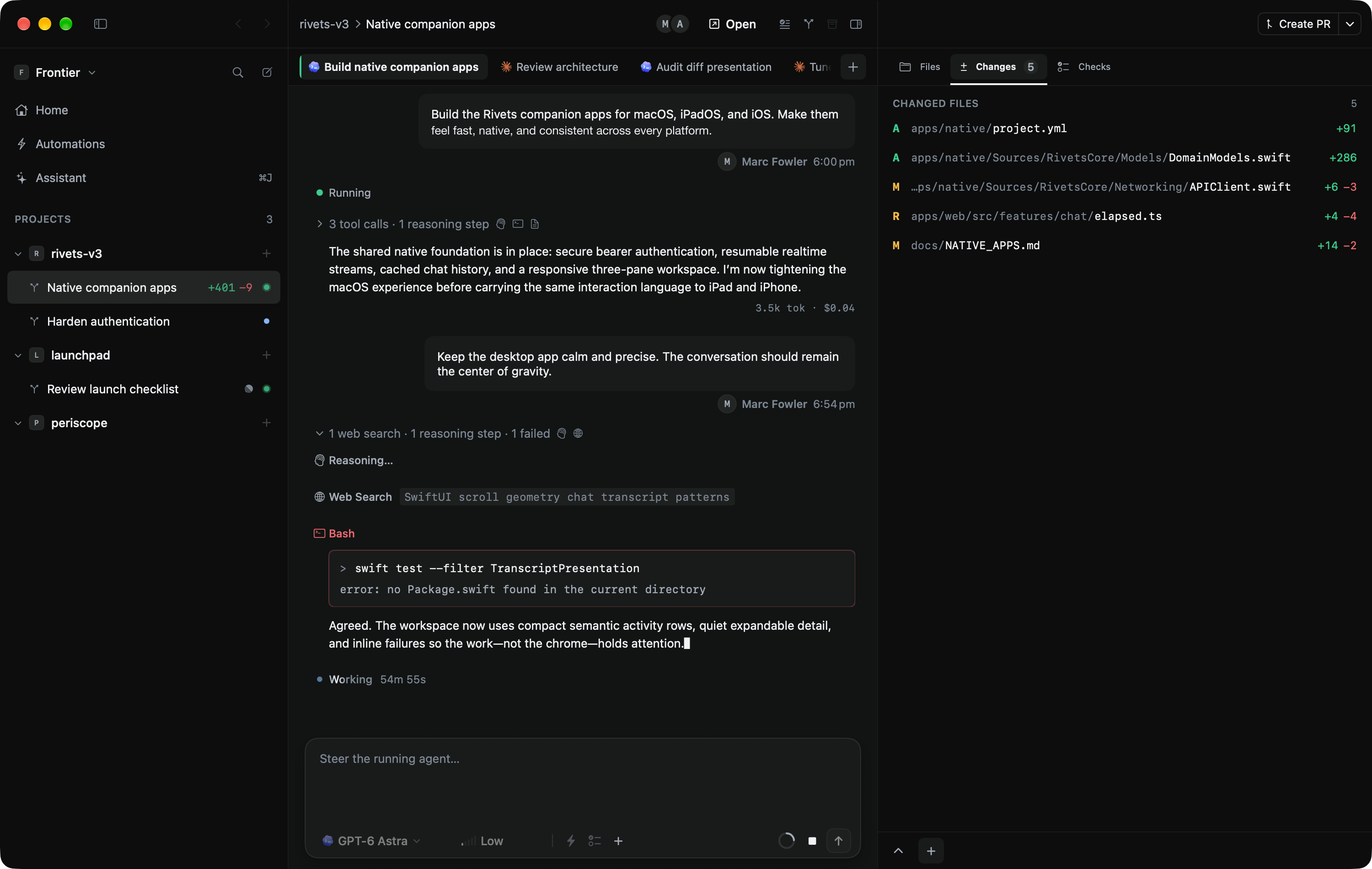
Rivets runs Claude Code and Codex on your own machines and streams every session to your team in real time. Start work from Linear, Slack, GitHub or your phone. Anyone can watch, and anyone can step in.
They write good code. But they run in one terminal, on one machine, for one person. Everyone else finds out when a pull request shows up.
01
The session lives in whoever started it. Teammates cannot see what the agent is doing, and nobody else can step in when it drifts.
02
Close the lid and the work stops, or you stop seeing it. There is no checking in from your phone on the way home.
03
The issue is in Linear, the thread is in Slack, the review is in GitHub. You copy it all into a prompt by hand.
Every task streams live to everyone with access to the repository. Watch the agent work, add context while it runs, and see exactly who said what.
See who is in the task and who is typing. Every member with access gets the same live stream.
Any member can message the running agent. Every message carries the name of the person who sent it.
Deliver a message now, or queue it. Queued messages can be edited, deleted or sent early before the agent takes them.
The Changes view follows the agent as it edits, refreshed after every write. Everyone reviews the same diff.
Issues, threads and pull requests already hold the context. Rivets picks up work where it lives and reports back there too.
Delegate or @mention Rivets on an issue and work starts. Progress, Agent Plans and follow-ups stay in sync, and the pull request links back with “Fixes ABC-123”.
Mention Rivets in a channel or DM the app. The assistant starts tasks, checks on them and answers in the thread. Each thread is one conversation.
Start a task from any pull request or branch. The Checks tab takes it the rest of the way, from push to merge.
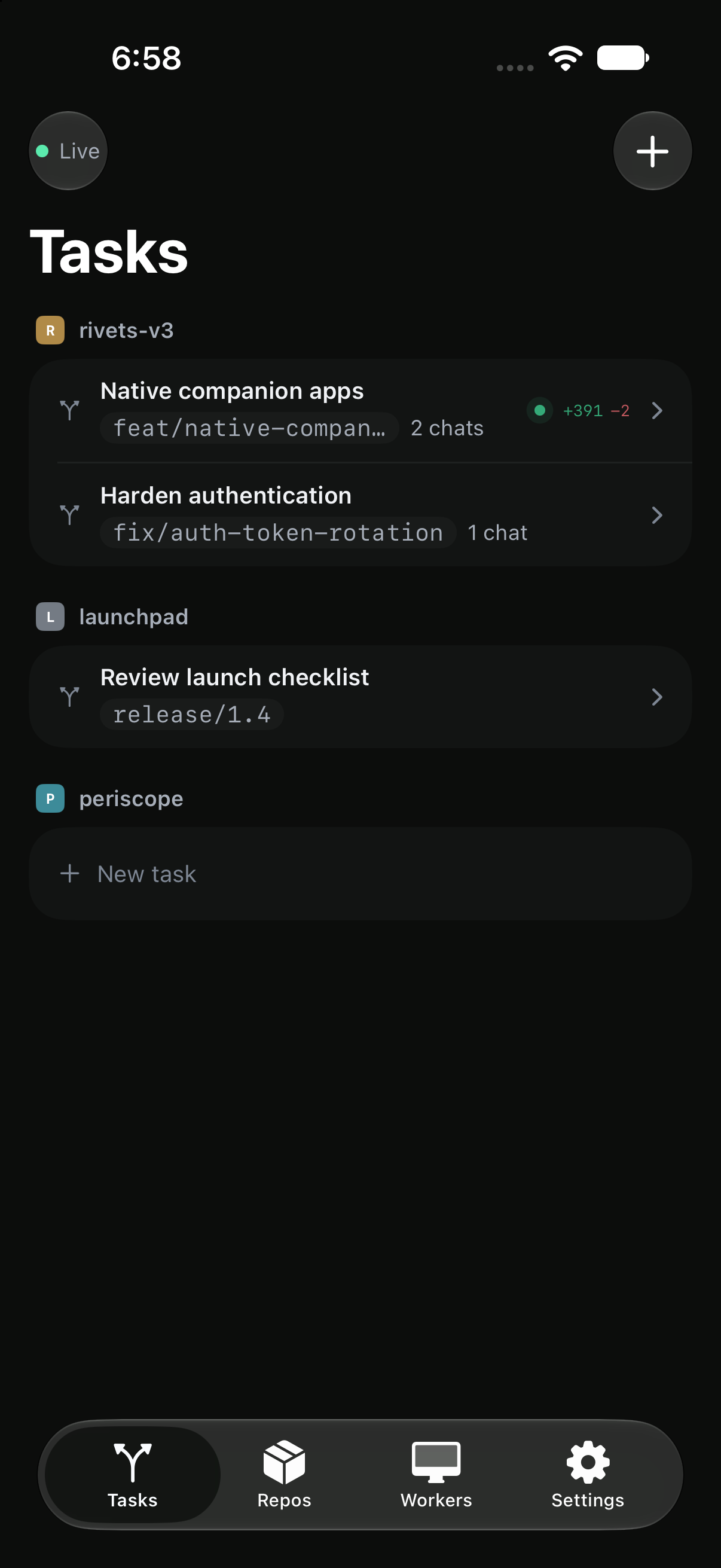
The Mac app has a project tree, a ⌘K palette and a worker built in. On iPhone and iPad, follow every task, steer the agent, and get a push when a job finishes.
Add app.rivets.dev/api/mcp with a personal token. 29 tools cover tasks, git and Linear.
Nothing to install. Start tasks, steer agents, review diffs and merge from any computer, at app.rivets.dev.
A worker is any machine running the Rivets CLI, or the Mac app. It runs Claude Code or Codex in a git worktree per task and streams the session back. Rivets never bills for inference.
Create a worker in Settings, paste the one-time token, and it is ready for tasks.
$ rivets worker connect --token-stdinAdd rivets worker install to keep it running as a per-user background service. It updates itself when idle.
Runs on
Install the Mac app and your Mac is a worker out of the box.
Pick the agent and model per run. Your defaults follow you across web, Mac and iPhone.
Claude Code
Codex
Per run
Every model call runs through your own CLI. Each worker reports its session and weekly usage.
The GitHub App issues short-lived tokens. The worker never reads your personal tokens or SSH keys.
Worker tokens live in the OS keychain, and every request is signed with a key held on the machine.
The Checks tab always shows the next step. Press it and Rivets does the git work, or hands the problem back to the agent.
Create PR
Title and description written for you
Push changes
Commit and push in one step
Checks
Runs, deployments and reviews
Resolve
Conflicts and review threads
Mark ready
Draft to ready for review
Merge
Squash, merge commit or rebase
PR titles, descriptions and commit messages come from your own agent. Text you wrote yourself is never replaced.
Rivets merges the base branch locally and asks the agent to resolve what conflicts. You choose to continue or abort.
Unresolved threads show up in Checks. Fix sends the thread straight to the agent working on the branch.
When the pull request merges, the task archives itself. That includes merges done on GitHub.
Run a saved prompt hourly, daily or weekly across repos. Each run is a normal task, and your app does not need to be open.
Define setup and run commands in .rivets/settings.toml. Every client gets a Run control, and output is visible to the team.
Open terminal tabs on the worker, or launch Claude Code or Codex interactively in one. Scrollback survives reconnects.
Tune the instructions behind task naming, commit messages, pull requests and code review, per organization, account or repository.
Hand a conversation to another agent with its recent transcript, or move it to another worker along with its files.
Group members into teams and grant each team the repositories it needs. Invite by email or link.
Two-factor sign-in with backup codes, signed worker requests, and native devices you can revoke from Settings.
Press ⌘J to ask what is running or to start a task. It delegates to your agents and runs on the cheapest model.
Rivets is a multiplayer coding-agent orchestrator. You connect your own machines as workers, send tasks to the Claude Code and Codex CLIs running on them, and watch and steer the sessions with your team in real time.
Claude Code and Codex. Claude models include Opus 5.5 (the default), Fable 5.1, Sonnet 5.5 and Haiku 4.5, plus earlier versions. Codex models are read from your installed CLI, including GPT-6 Astra, Sol and Luna. You choose the model, reasoning effort, fast mode and plan mode for each run.
No. Every model call runs on a worker through your own Claude Code or Codex CLI, on your own subscription. Rivets has no AI of its own and never bills for inference.
Agents run on your machines, in a git worktree per task. The Rivets backend relays the session to your team and stores snapshots of git status and diffs after each edit, which power the live Changes view. Repositories are cloned onto your workers using short-lived tokens from the Rivets GitHub App.
Yes. Anyone with access to the repository can watch the stream and steer the agent. Each message is attributed to its sender. You can interrupt the agent right away or queue a message, and queued messages can be edited or sent early.
Workers run on macOS, Linux and Windows, on arm64 and x64. The apps run on the web, macOS 15 and later, and iOS and iPadOS 18 and later. The iPhone and iPad app follows and steers work but never runs a worker.
No. I build Rivets at Frontier.sh, and your agents run on your own machines with your own Claude Code or Codex subscription.
Rivets is free while it’s in beta. At launch I’ll offer special launch pricing for early teams, then lifetime licenses after that. Model usage always runs on your own Claude and Codex subscriptions, so Rivets never bills for inference.
Early access is rolling out now. Join the list and I’ll get in touch as soon as I can.
Rivets is rolling out in early access. Leave your email and I’ll get in touch as soon as I can.